By Robert Wright, BM-ESB, Mr. Web Guru
If you want to understand why AI suddenly feels like it’s everywhere — in your phone, your browser, your inbox, your apps — you can’t start in 2022. You have to rewind to 2004, the year the internet quietly reinvented itself.
This was the birth of Web 2.0, and it changed everything.
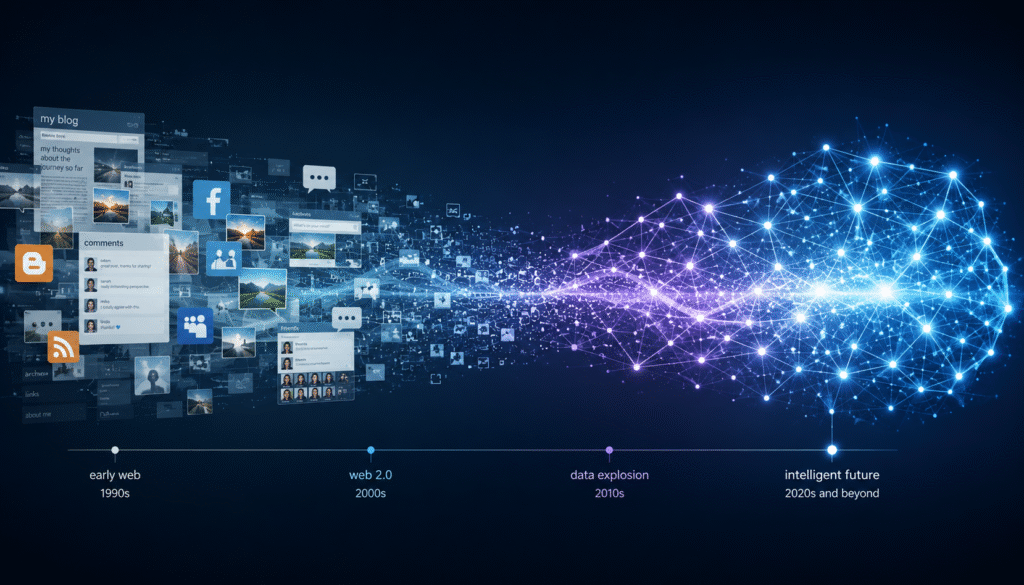
Not because of flashy tech. Not because of algorithms. But because the internet stopped being a static library and became a living ecosystem powered by people.
And that shift created the perfect conditions for modern AI to sprout, grow, and eventually explode.
Let’s break it down.
The Internet Before the Transformation
To appreciate what Web 2.0 unlocked, you have to remember what came before it. The early internet — what we now call Web 1.0 — was a quiet, almost polite place. Websites sat still. Pages didn’t talk back. You visited a site, read what was there, and left. It was a one‑way street, a digital library where the books never changed and the shelves never rearranged themselves.
Useful? Absolutely. Dynamic? Not even close.
There was no social layer, no feedback loops, no constant stream of human expression. And without that, there was nothing for machines to learn from. AI needs patterns, and Web 1.0 simply didn’t generate enough of them.
Everything changed when the internet stopped being a collection of documents and became a reflection of human behavior.
The Web Wakes Up
Around 2004, the internet took a deep breath and came alive.
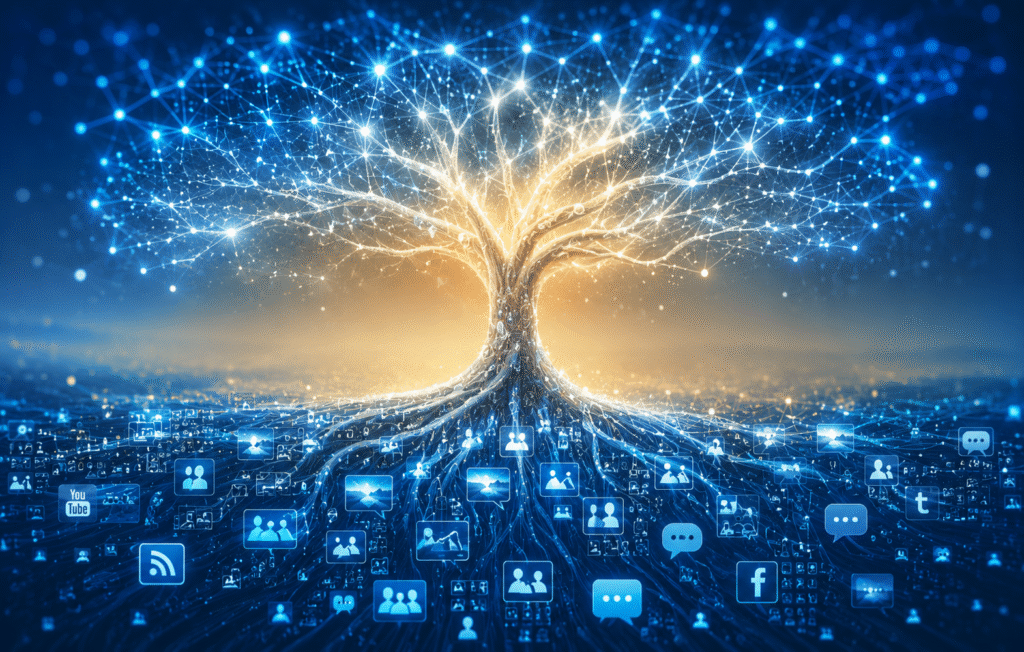
Suddenly, people weren’t just reading the web — they were writing it, shaping it, feeding it. Social networks appeared. Comment sections opened. Photos and videos poured online. Blogs multiplied. Platforms invited participation instead of passive consumption.
The web became a conversation, not a bulletin board.
And with that shift came something revolutionary: data — not in trickles, but in torrents.
Every post, every upload, every tag, every like, every argument, every shared moment became part of a massive, ever‑expanding archive of human behavior. For the first time in history, the digital world had a memory rich enough for machines to learn from.
Why This New World Was Perfect for AI
Artificial intelligence doesn’t emerge from thin air. It grows out of patterns — language patterns, visual patterns, behavioral patterns. Before Web 2.0, those patterns were scarce. After Web 2.0, they were everywhere.
The internet had become a living laboratory of human expression. Billions of examples of how we talk, what we look at, what we choose, what we ignore, what we love, and what we argue about. It was messy, chaotic, and beautifully human — exactly the kind of environment where machine learning thrives.
AI didn’t need perfection. It needed volume, variety, and velocity. Web 2.0 delivered all three.
The Quiet Infrastructure Revolution
While the social web was exploding on the surface, something equally important was happening underneath. Companies were building massive data centers to handle the flood of photos, videos, and interactions. Cloud computing matured. Storage became cheap. Processing became scalable. The backbone of the modern internet hardened and expanded.
This wasn’t built for AI — but AI would later depend on it.
The same systems that kept your MySpace profile online or your YouTube videos streaming would eventually become the machinery that trained neural networks. The infrastructure of Web 2.0 became the foundation of the AI era.
From Seeds to Sprouts
By the time researchers revived deep learning in the late 2000s, the world had already prepared the soil. The data was there. The infrastructure was there. The social web had done its part.
AI didn’t burst onto the scene suddenly. It grew quietly in the background, nourished by the digital ecosystem we were all building without realizing it. Every upload, every comment, every shared moment was another drop of water on the seed.
And eventually, the sprout broke through the soil.
Why This Story Matters
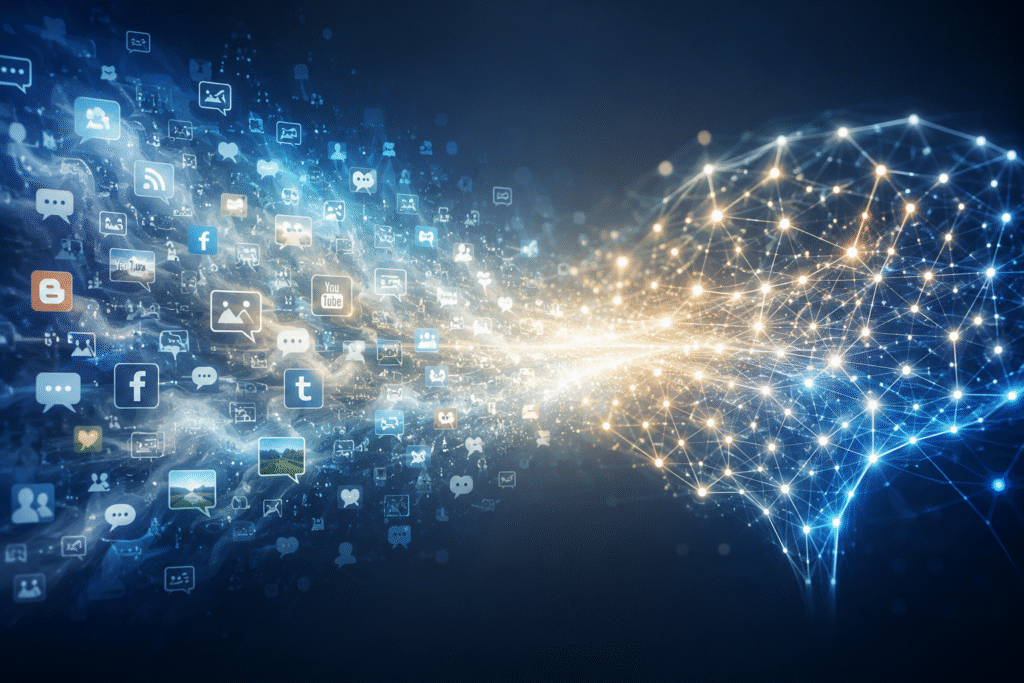
Understanding the connection between Web 2.0 and modern AI isn’t just a history lesson — it’s a reminder of something deeper:
AI didn’t appear out of nowhere. It grew out of us.
Out of our conversations. Our creativity. Our curiosity. Our chaos.
The internet became human, and AI learned to understand humans because of it.
Web 2.0 wasn’t just a redesign of the internet. It was the moment the digital world became fertile ground — and everything that followed, from recommendation engines to chatbots, grew from that transformation.